How Slime Mold Solves Problems Without a Brain
How Slime Mold Solves Problems Without a Brain
A maze usually presents a problem for a brain: examine alternatives, remember dead ends, and select the best route. Yet a single-celled organism can produce surprisingly efficient paths through a maze without neurons, muscles, or a central nervous system.
The organism is Physarum polycephalum, a plasmodial slime mold. In laboratory experiments, it connects food sources through maze networks, abandons unproductive branches, and reorganizes its body after environmental changes. It does not draw a map or consciously calculate distances. Its behavior emerges from growth, chemical signaling, fluid movement, and feedback.
This is not intelligence in the human sense. It is adaptive problem-solving produced by simple local processes interacting across a living network. The organism explores its surroundings, reinforces useful routes, and allows inefficient routes to disappear. Physics performs much of the “computation.”
What Is Slime Mold?
Slime Mold Is Not a Typical Mold
Despite its name, slime mold is not a fungus. Slime molds belong to unrelated groups of amoeba-like organisms and are distinct from plants, animals, and bacteria.
This article focuses on Physarum polycephalum, a species widely used to study biological self-organization and decentralized behavior. Researchers favor it because it grows visibly across moist surfaces, responds to nutrients, and forms a branching tubular network that can be measured in experiments.
During one stage of its life cycle, P. polycephalum exists as a plasmodium: a large, mobile cell that feeds on microorganisms and organic material.
The Giant Single Cell
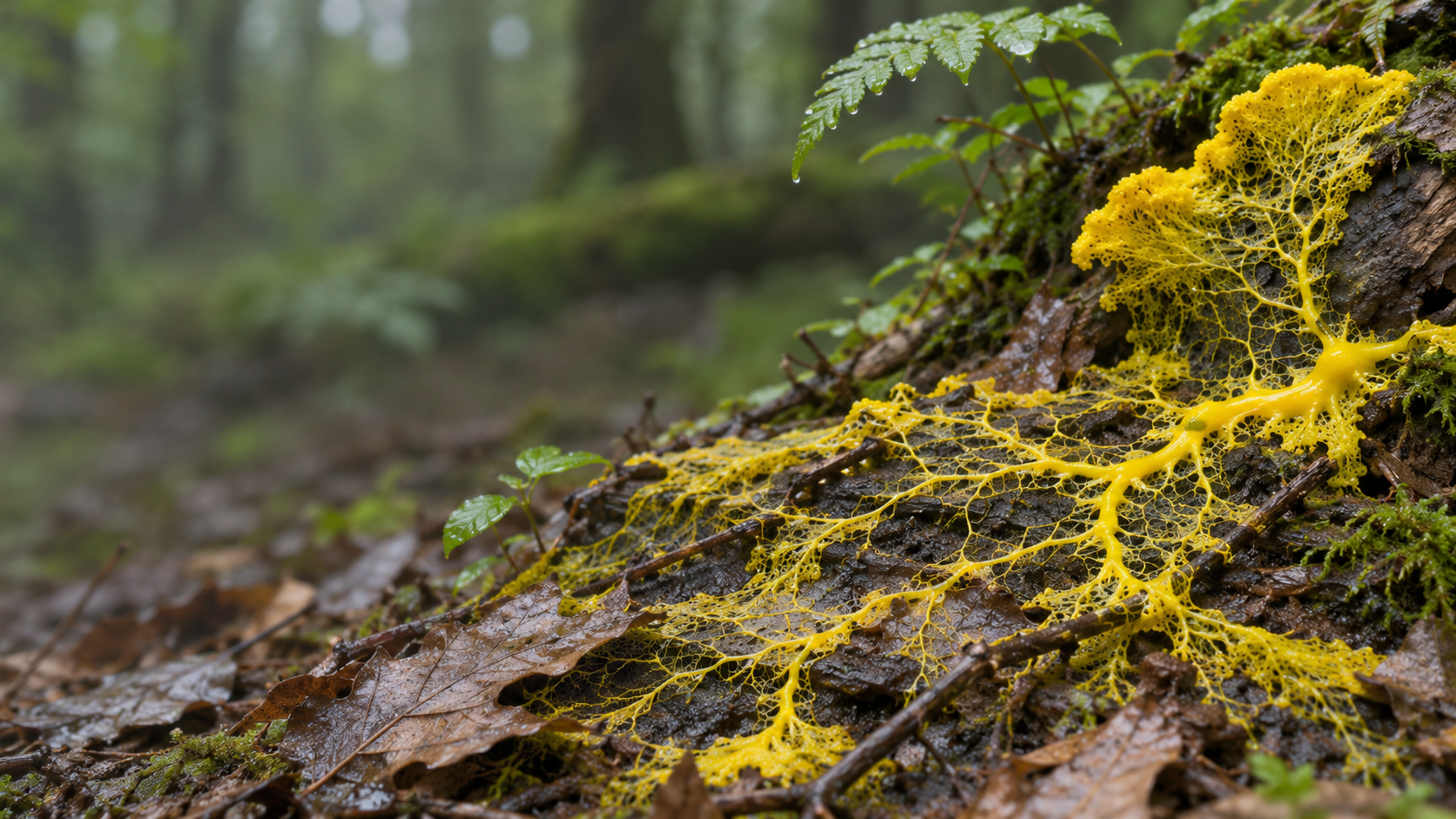
A plasmodium is one cell containing many nuclei. It can spread across a surface as a soft, yellowish mass. Rather than using separate organs, it uses different regions of the same cell for sensing, movement, digestion, and transport.
Its body forms tubes that carry nutrients and chemical signals through rhythmic flows of internal fluid. The organism can widen some tubes, narrow others, create new branches, and retract old ones.
This structure gives slime mold an unusual combination of simplicity and coordination. It has no brain, but its entire body participates in sensing and responding to the environment.
What “Brainless” Means
“Brainless” means that Physarum has no brain, neurons, or centralized nervous system. It does not process information through a specialized control center.
That does not mean it is unresponsive. The organism detects chemical conditions, moisture, light, nutrients, and physical obstacles. It changes its growth and internal transport in response.
The distinction matters. Slime mold behavior should not be described as conscious planning unless evidence supports that claim. Its maze-solving behavior is better understood as adaptive biological organization.
The Physical System Behind Slime Mold Behavior
Growth Toward Food and Favorable Conditions
Slime mold extends through its environment by sending out exploratory growth. When one region encounters nutrients, chemical signals influence nearby growth and transport.
The organism does not immediately choose one direction. It can spread into several possible routes at once, allowing it to test the environment physically and in parallel.
A favorable route gains support when it reaches food or connects useful regions. Nutrient transport through that route becomes stronger, encouraging the tube to remain active or expand. Routes that produce little benefit receive less support.
This process resembles trial and error, but no central agent performs the trial or evaluates the result. The organism’s structure changes as a direct consequence of local conditions.
Rhythmic Internal Fluid Flow
The tubes of Physarum contain cytoplasm that moves back and forth. Rhythmic contractions push fluid through the network, transporting nutrients and chemical information.
A tube that carries substantial flow can become wider and more stable. A tube that carries little flow can weaken and shrink. The network therefore changes its own transport capacity.
The result is a feedback cycle:
- The organism extends into available space.
- Some routes encounter nutrients or connect important regions.
- Successful routes carry stronger internal flow.
- Stronger flow supports wider or more persistent tubes.
- Weakly used routes contract and disappear.
The organism’s final structure can appear planned, even though no central plan exists.
Local Rules Create Global Patterns
A centralized system gives instructions from a control center. A self-organizing system produces large-scale order through local interactions.
In slime mold, each region responds to nearby chemical conditions, fluid pressure, nutrient availability, and mechanical changes. Those local responses affect neighboring regions. Over time, the whole network changes.
The global result can be an efficient connection between food sources. The organism does not need a complete map. It needs only local rules that favor useful transport and reduce waste.
How Slime Mold Navigates a Maze
The Classic Maze Experiment
In a landmark experiment, researchers placed oat flakes, which provide nutrients, at positions corresponding to food sources in a maze. They introduced P. polycephalum into the maze and observed how its body spread through the available corridors.
The slime mold initially explored multiple routes. After reaching the food sources, it reorganized. Many branches disappeared, while a shorter connection between the food locations remained. The resulting path closely matched an efficient route through the maze Source 1.
The organism did not see the maze as a symbolic diagram. It physically occupied the corridors, sensed local conditions, and adjusted its network according to transport success.
Why Dead Ends Fade Away
A branch that does not connect useful food sources receives less nutrient flow. Reduced flow lowers the branch’s ability to maintain itself. The tube can narrow, weaken, and retract.
This pruning process removes unnecessary routes without requiring a separate “delete” command. A route persists only when the network continues to support it.
The process resembles natural selection at the level of pathways. Productive routes persist; less productive routes decline. The comparison is limited because a tube is not an organism evolving across generations, but the principle of differential persistence is useful.
What the Maze Result Shows
The maze experiment demonstrates adaptive exploration and network optimization. It does not demonstrate human-like reasoning, conscious planning, or an abstract understanding of maze geometry.
The slime mold reaches an efficient result because its physical body embodies the search process. Exploration, transport, reinforcement, and pruning happen within one continuously changing system.
How Physics Helps Slime Mold Solve Problems
Feedback and Reinforcement
Positive feedback strengthens successful routes. A productive tube transports more nutrients and cytoplasm. That stronger transport supports the tube, making it more capable of carrying resources.
Negative feedback weakens unproductive routes. A branch that carries little useful flow receives less structural support and begins to retract.
Both forms of feedback are necessary. Positive feedback alone could make the first route dominate, even if it were not the best. Negative feedback alone could remove too many exploratory branches. Their interaction allows the organism to explore first and optimize later.
Flow Through a Living Network
Fluid generally moves more easily through a wider or less resistant tube. When flow becomes concentrated in a route, that route can receive further reinforcement.
This creates a biological form of network adaptation. Transport and structure influence each other:
- Tube geometry affects fluid flow.
- Fluid flow affects tube geometry.
- Tube geometry affects nutrient transport.
- Nutrient transport affects future growth.
The analogy with engineered pipes or roads is useful but not exact. Living tubes actively contract, sense chemical conditions, change their material properties, and repair themselves. They are not passive pipes.
Efficient Connections and Trade-Offs
The shortest route is not always the best biological route. A network may need to balance several goals:
- Short total path length
- Reliable nutrient transport
- Redundant connections
- Resistance to damage
- Access to several food sources
- Low construction and maintenance costs
Researchers modeled these trade-offs in a study showing that Physarum can produce networks with properties similar to human transportation systems. The slime mold often achieved efficient connections while retaining some redundancy, rather than producing a single fragile line Source 2.
Its solution is therefore often near-optimal, not mathematically perfect. Biological systems operate under changing conditions and limited resources.
Self-Organization
Self-organization occurs when coordinated structure emerges without centralized control. Examples include ant trails, flocking birds, crystal formation, traffic patterns, and some chemical reactions.
Slime mold provides a clear biological example because its body directly becomes the network. The same material both senses the environment and responds to it. Its transport system is also a decision-making system in the limited biological sense of changing behavior according to conditions.
Slime Mold as a Distributed Information Processor
No Brain Does Not Mean No Information Processing
Information processing does not require a computer chip or nervous system. In Physarum, information is represented through:
- Chemical concentration
- Fluid pressure
- Tube thickness
- Growth rate
- Contraction rhythm
- Nutrient distribution
- The presence or absence of neighboring branches
The organism’s current structure records something about its recent environment. A thick, active tube indicates sustained support. A retracted branch indicates that conditions no longer justify its maintenance.
This is a form of embodied information storage. The information is not stored in a separate memory center; it is expressed through the changing physical state of the body.
The Body Acts as Sensor and Computer
A slime mold network can detect nutrients, transport resources, compare routes, and reinforce useful paths. These functions are not separate stages controlled by a brain.
Sensing changes growth. Growth changes geometry. Geometry changes flow. Flow changes reinforcement. The body continuously computes through these interactions.
This kind of computation is physical rather than symbolic. The organism does not manipulate a written representation of a maze. Its body explores the actual environment and lets material processes determine which routes remain.
Distributed Decisions
Different parts of the organism respond locally. A region near food may grow more actively, while a region in a poor environment retracts. Fluid and chemical signals connect these local responses across the network.
The resulting behavior is coordinated without centralized command. This is distributed problem-solving: a system reaches a useful outcome through many local interactions.
The phrase does not mean that every tube “thinks.” It describes how information and control are spread throughout the organism rather than concentrated in a brain.
Other Problems Slime Mold Can Address
Connecting Multiple Food Sources
When food is placed at several locations, slime mold can form a network connecting them. The network may resemble a transportation system, with shorter main routes and additional branches that provide resilience.
Researchers have compared these living networks with infrastructure such as roads, railways, and communication links. The comparisons help scientists study how efficient systems balance length, cost, and robustness.
Such networks are not automatically better than human designs. They offer models and principles that engineers can test under specific constraints.
Responding to Environmental Change
Slime mold can restructure its network when conditions change. It may respond to:
- A food source moving or disappearing
- Damage to part of the network
- Dryness
- Light exposure
- Unfavorable chemicals
- A newly available nutrient source
A network that remains permanently fixed would fail when its environment changed. Continuous growth and pruning allow the organism to adapt.
Balancing Exploration and Efficiency
Exploration carries a cost. Building many branches consumes energy and material. However, immediate pruning is also risky because an apparently useless route may lead to food discovered later.
Slime mold therefore faces an exploration-versus-exploitation trade-off. It must explore enough territory to find resources, then reduce unnecessary growth after useful routes become clear.
This balance appears in many biological systems and computer algorithms. In slime mold, it is achieved through changing growth rates and flow reinforcement rather than explicit calculations.
What Slime Mold Teaches About Intelligence
Intelligence May Be a Spectrum
The word “intelligence” can refer to several different properties:
- Conscious thought
- Learning
- Adaptation
- Environmental responsiveness
- Optimization
- Flexible behavior
Slime mold clearly demonstrates adaptation and complex environmental responsiveness. Whether it should be called intelligent depends on the definition being used.
There is no strong evidence that Physarum possesses human-like consciousness, language, or abstract reasoning. Its behavior is nonetheless sophisticated enough to challenge the idea that useful problem-solving begins only with brains.
Intelligence Can Be Embodied
Embodied intelligence describes behavior produced by the interaction of body, environment, material properties, and feedback.
In slime mold, physical structure performs tasks that a conventional computer might calculate. Tube widths encode transport priorities. Flow distributes resources. Growth tests possible routes. Retraction removes less useful alternatives.
The “algorithm” is not separate from the organism. It is expressed through the organism’s body.
Simple Rules Can Produce Complex Behavior
The core rules are relatively simple:
- Sense local conditions.
- Extend into available space.
- Reinforce routes carrying useful flow.
- Retract routes receiving little support.
- Reorganize when conditions change.
Together, these rules produce complex network behavior. Complexity does not always require complex instructions. It can emerge from repeated interactions across time.
This principle influences artificial life, adaptive robotics, swarm intelligence, and unconventional computing.
Limits of the Slime Mold Analogy
It Does Not Think Like a Human
Slime mold does not appear to possess language, conscious goals, abstract concepts, or self-awareness. Describing it as “choosing” a route is often a convenient metaphor for a physical process.
Careful explanations should distinguish observed behavior from human interpretation.
It Does Not Always Find the Perfect Solution
Slime mold solutions depend on conditions such as nutrient placement, maze geometry, moisture, temperature, light, and the organism’s growth state.
A route that is optimal in one experiment may be unsuitable in another. The organism produces adaptive and often efficient solutions, not universal mathematical optima.
Laboratory Findings Need Careful Interpretation
Researchers should distinguish among direct observations, mathematical models, human descriptions, and engineering applications.
A slime mold network can inspire a transportation algorithm, but a real road system must also account for terrain, construction costs, safety, regulations, maintenance, and public needs.
Applications Inspired by Slime Mold
Network Design
Slime mold behavior has inspired computational methods for designing:
- Roads
- Rail systems
- Communication networks
- Delivery routes
- Utility connections
The biological process generates candidate networks by strengthening useful links and weakening inefficient ones. Engineers then evaluate those candidates against real-world constraints.
Robotics and Artificial Life
Researchers can model slime mold principles in robots and simulations. Applications include decentralized control, adaptive pathfinding, self-repair, and coordination among multiple units.
A soft, distributed system is especially relevant to environments where rigid central control is unreliable. A robot inspired by slime mold might explore several routes, preserve useful connections, and reorganize after damage.
New Approaches to Computing
Unconventional computing uses physical processes to perform useful operations. Slime mold research has contributed to interest in chemical gradients, fluid networks, living materials, and self-organizing systems.
These approaches will not replace conventional computers for most tasks. They may be useful when adaptation, low energy use, physical sensing, or self-repair matters more than high-speed symbolic calculation.
Conclusion: A Living Network That Computes Through Physics
A slime mold solves environmental problems without a brain by combining growth, fluid flow, chemical signaling, and feedback.
It explores multiple routes. Nutrients and internal flow reinforce useful connections. Inefficient branches lose support and disappear. The remaining network can connect food sources with surprising efficiency.
The organism does not consciously understand a maze. Its behavior is not human intelligence. It is a form of distributed, embodied problem-solving in which physics and biology perform work normally associated with computation.
The broader lesson is significant: nature can produce organized and efficient behavior without a central controller. Simple local processes, repeated across a changing network, can generate solutions that look remarkably intelligent.
Takeaway
- Slime mold explores.
- Physics reinforces useful routes.
- The organism prunes inefficient paths.
- The resulting network solves practical problems.
FAQ
Can slime mold solve a maze without a brain?
Yes. In maze experiments, Physarum polycephalum can form an efficient connection between food sources. It does so through growth, chemical signaling, fluid flow, and route reinforcement rather than conscious planning Source 1.
Does slime mold have intelligence?
Slime mold shows adaptive behavior and distributed problem-solving without evidence of human-like consciousness. Scientists may describe its behavior as primitive cognition or biological information processing, but those terms should not imply thought, language, or self-awareness.
How does slime mold know which path is best?
It does not evaluate paths symbolically. Routes that reach nutrients or connect useful regions receive stronger internal transport and structural support. Less useful routes carry less flow and gradually shrink.
What is Physarum polycephalum?
Physarum polycephalum is a plasmodial slime mold species commonly studied in biology, physics, and network science. Its large visible body, rapid growth, and measurable tubular network make it useful for experiments on adaptation and self-organization.
Can slime mold remember information?
Its changing network and chemical state can preserve temporary effects from previous conditions. This is a form of biological or embodied memory, not memory stored in a brain. Experiments have shown that previous exposure to certain conditions can influence later behavior Source 3.
Can slime mold networks improve human transportation systems?
They can inspire network-design methods, especially for balancing efficiency and resilience. Real transportation systems require additional factors, including cost, safety, terrain, regulations, population needs, and maintenance. Slime mold provides a source of design principles, not a complete replacement for engineering.
Related Articles
-
 Webb Finds Farthest Little Red Dot Yet
-
 Japan Unveils LUPEX Rover for Lunar Water Mission
-
 South Pole Telescope Maps Matter in the Distant Universe
-
 Voyager 1 Reaches One Light-Day as Data Loss Is Investigated
-
 Hera Finds Chaotic Aftermath of NASA’s DART Impact
-
 Hubble’s Ocean of Stars Helps Prepare for Roman
-
 Earth’s New Moonlet Revives a 1878 Prediction
-
 Slime Mold Intelligence: Physics, Biology, or Both?
-
 Hera Reveals DART’s Stadium-Sized Asteroid Crater
-
 MoS₂: The Bizarre Material That Could Shape Future Chips
-
 Hera Reveals Close-Up Views of Dimorphos After DART
-
 Cancer Drug Developed in Space: What We Know
-
 The Wolverine: Predator That Challenges Bears and Lions
-
 Ancient Quasar Found 630 Million Years After Big Bang
-
 November Beaver Moon Livestream: Watch the 2026 Supermoon
-
 APOD Nov. 25, 2026: SPHEREx Sees Through Dust